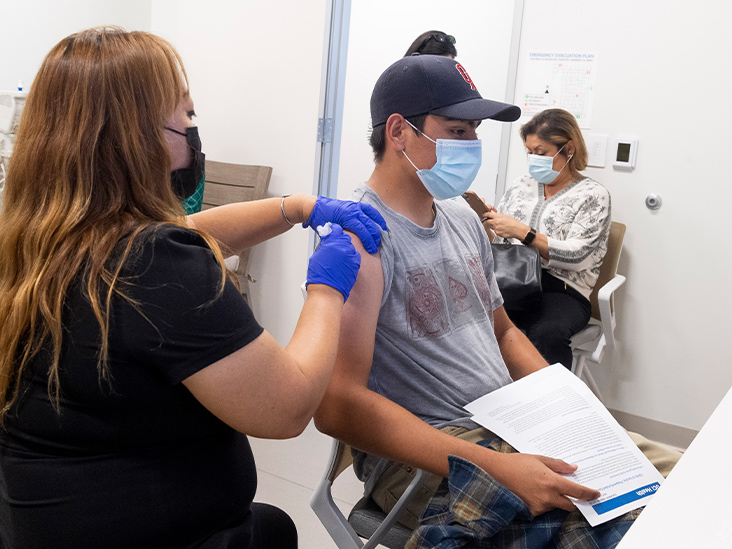
An archived look at how US regulators and doctors discussed vaccinating 12- to 15-year-olds in 2021, and what it meant for multigenerational households.
The news below dates from May 2021 and describes events in the United States. It is kept as an archive, not as guidance. Vaccines, eligibility rules and recommendations have all moved on since then. Families in Sydney and elsewhere in Australia should look to health.gov.au for current information and talk with their GP before making decisions about vaccination for children, teenagers or anyone in their care.
For a home care provider, one detail in the 2021 coverage stands out. Epidemiologists quoted in US reports at the time argued that vaccinating young people living in multigenerational homes could help shield the adults they lived with, particularly grandparents or family members who were unvaccinated or had weakened immunity. They reminded readers that children can pass the virus on and that many at-risk adults had not yet been vaccinated.
Many of the people we support live with or near younger relatives, so questions about how infection moves through a household were very real for families at the time.
According to US federal officials speaking to The New York Times, the Food and Drug Administration (FDA) was poised in May 2021 to clear the Pfizer-BioNTech COVID-19 vaccine for 12- to 15-year-olds. Until then, US authorisation covered only those aged 16 and older.
The companies had applied in early April 2021 to amend the emergency use authorisation (EUA) granted the previous December. Late in March, they had announced phase 3 results from a trial in just over two thousand young adolescents, reporting very high efficacy, good tolerability and antibody levels comparable to those of trial participants aged 16 to 25.
Paediatric specialists interviewed for US coverage welcomed the step, saying this age group mattered both because young teens could catch the virus and because they could spread it.
The FDA had issued the first EUA in December 2020, following a public session of its Vaccines and Related Biological Products Advisory Committee (VRBPAC). As the 2021 application only sought to change an existing authorisation, no fresh committee hearing was anticipated.
After any FDA decision, the immunisation advisers of the Centers for Disease Control and Prevention (CDC) were expected to meet quickly to consider a recommendation for the new age group.
Younger children were next in line for research. Pfizer was enrolling participants between 6 months and 11 years of age, while Moderna was running an adolescent trial and recruiting the same younger age range for a further study.
Severe illness was less common in children than in adults, but doctors were careful to say the risk was not nil.
Commentators at the time also linked vaccinating teens with wider community protection, noting that a sizeable proportion of American adults remained unvaccinated. Early research hinted that vaccination might reduce onward transmission, though this was still being investigated.
Paediatric specialists in US reports believed broader coverage could shorten the pandemic, but flagged the vaccine’s need for ultra-cold storage. That requirement made it harder for community health centres to offer the vaccine, and they felt parents would rather their children be vaccinated by a familiar paediatrician than at a pharmacy or stadium.
Not everyone saw the move in purely positive terms. Biostatistician Natalie Dean, PhD, of the University of Florida, posted on Twitter that while teenagers should have access, there was an ethical tension in vaccinating low-risk adolescents in wealthy nations before high-risk adults elsewhere. The Washington Post reported in April 2021 that close to half of all doses administered globally had gone to high-income countries.
Other specialists quoted at the time took the view that protecting vulnerable people overseas and vaccinating American teens could proceed side by side, and the Kaiser Family Foundation set out steps the US government could take to promote fairer worldwide distribution.
Homeland Care bases its infection-control practices on current Australian health advice. If you are unsure what applies to you or your family, your GP is the best person to ask, and health.gov.au carries the latest official guidance.


 Relationships (7)
Please Login or Sign up to be able to comment